
Test Structural Concentration With Your Own CSV Data: Ω Minimal CSV Template

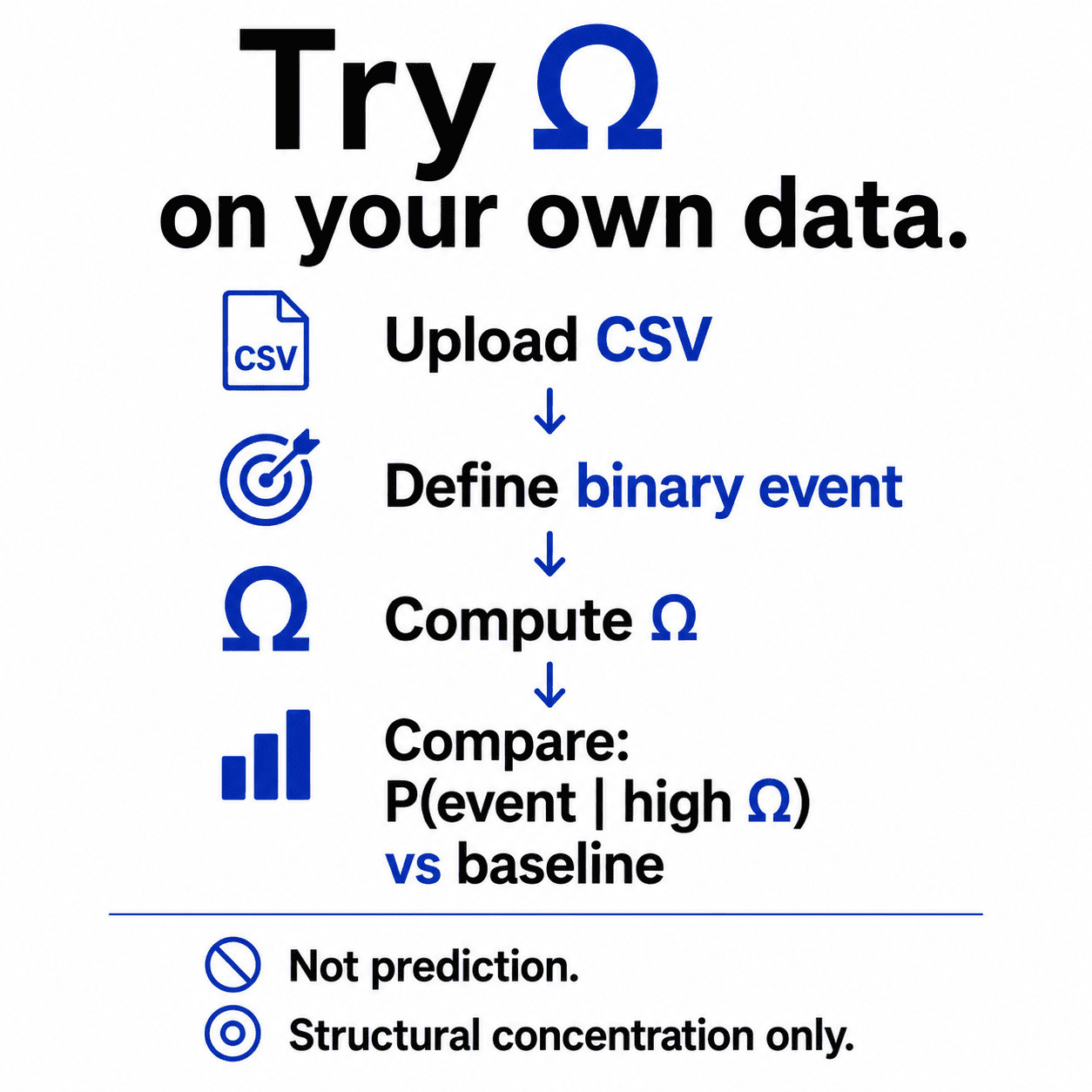
I have published a minimal executable template that lets external readers test whether binary events in their own CSV data concentrate in high-Ω states.
This is not a prediction model.
It is not an AI system for forecasting the future.
The purpose is more limited:
to test whether independently defined binary events structurally concentrate in high-Ω states under fixed ex-ante definitions.
This template is designed as a minimal reproducibility structure.
---
Background
So far, the Ω framework has been tested across multiple domains, including:
- finance
- crypto assets
- earthquakes
- weather
- traffic
- electricity markets
- physiological time series
- ecological systems
- GitHub / Wikipedia activity
Across these domains, the core question has been:
Do event-like transitions concentrate in high-Ω states?
The tests use fixed definitions.
They do not tune Ω after seeing the result.
They do not define events from Ω.
They compare:
P(event | high Ω)
against the baseline event probability.
However, for external readers, there was still friction.
To test the framework with their own data, a reader often had to deal with:
- data formatting
- notebook editing
- column-name adjustment
- event-definition implementation
The Ω Minimal CSV Template is intended to reduce that friction.
---
What This Is
The Ω Minimal CSV Template is a minimal executable workflow for applying a structural concentration test to user-provided time-series data.
It computes Ω, defines high-Ω states, and checks whether independently defined events concentrate there.
The event is not created from Ω.
The event must be defined independently.
For example, an event may be:
- a day above a fixed threshold
- an externally defined anomaly
- a collapse-like event
- a transition-like event
- a binary event defined by an external rule
The important point is that the event definition remains independent from Ω.
---
What You Can Test
With your own CSV, you can check:
- whether events concentrate in high-Ω states
- how that compares with the baseline event probability
- how large the concentration ratio is
The main output values are:
- P(event | high Ω)
- baseline P(event)
- ratio
- n_rows
- n_high
- n_event_high
The central comparison is:
P(event | high Ω) vs baseline P(event)
This is not prediction accuracy.
It is not classification performance.
It is not causal inference.
It only asks whether structural concentration is present under the chosen fixed definitions.
---
Required CSV Format
The minimal CSV requires three basic components:
- timestamp or order
- value
- binary event
The notebook can run with a minimum of 20 rows.
However, this is only a lower bound for execution.
Meaningful interpretation requires enough rows for the domain and event definition being tested.
If events are extremely rare, or if the dataset is very small, the result should be interpreted cautiously.
Null results are valid.
If events do not concentrate in high-Ω states, that is not a failure.
It simply means that, under the chosen definitions and dataset, structural concentration was not observed.
---
What Was Added
This release includes:
- an executable notebook (.ipynb)
- a minimal sample CSV
- a PDF overview
- a report-ready output structure
- links to the Ω Library and Ω Reference Guide
The notebook is designed for direct execution in Google Colab.
The sample CSV allows readers to first confirm that the workflow runs, then replace it with their own data.
---
Start Here
Run directly in Google Colab:
Ω Minimal CSV Template:
https://zenodo.org/records/20309117
Ω Reference Guide:
https://zenodo.org/records/20107274
For the broader structure:
Ω Library:
https://github.com/onsenojisan/omega-library
---
About the Ω Reference Guide
The Ω Reference Guide is not the main theory text.
It is an external navigation document for the Ω Library and related public artifacts.
Its purpose is to separate:
- canonical theory
- reproduction layers
- cross-domain examples
- noncanonical analyses
This is meant to simplify the entry structure.
It helps clarify:
- where to start
- which artifact is executable
- which document is the canonical reference
- which materials are examples or extensions
---
Important Boundaries
This framework does not claim:
- prediction
- causality
- optimization
- proof of a universal law
It only asks whether structural concentration is present.
The definitions must be fixed before evaluation.
The key constraints are:
- the event definition must be independent from Ω
- the high-Ω threshold must be fixed ex ante
- results should be reported as P(event | high Ω) against baseline
- null results are valid
A positive result does not imply endorsement of the full theory.
---
Current Status
The current claim is limited.
In the reported tests across several independent domains, event-like transitions have tended to appear more often in high-Ω states under fixed definitions.
The Ω Minimal CSV Template is a participation layer for testing that structure with user-provided data.
It does not require endorsement of the full framework.
It allows external readers to test their own data, inspect the result, and report it in the same minimal format.
At this stage, the priority is:
- reproducibility
- simpler entry points
- fixed definitions
- cross-domain consistency
The Ω Minimal CSV Template is a minimal execution layer for that purpose.